The Power of the Unexpected: Why Elite Communities Are Abandoning the Grand Reveal

Photo: Matsujima, CC BY-SA 4.0, via Wikimedia Commons
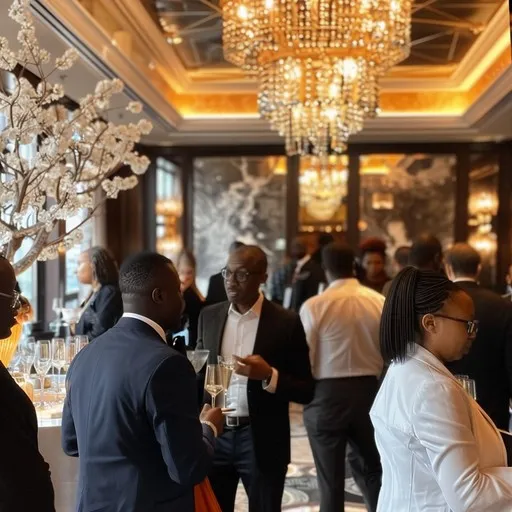
Consider two scenarios. In the first, a membership club sends a polished email announcement three weeks in advance, informing members that a celebrated guest will appear at next month's gathering. In the second, members arrive at what appears to be a standard evening event and discover, without any prior notice, that the same celebrated guest is already in the room, engaged in conversation near the bar.
The information is identical. The guest is the same. The only variable is anticipation — and yet the emotional response, the social behavior, and the long-term loyalty generated by these two experiences are categorically different. Understanding why this is the case is the strategic insight that separates the most enduring elite communities from those that simply manage a calendar of events.
The Psychology of Anticipated vs. Discovered Delight
Behavioral researchers have long documented the asymmetric emotional impact of expected versus unexpected positive experiences. When a reward is anticipated, the brain begins processing it the moment the expectation is formed. By the time the experience arrives, a portion of its emotional potency has already been consumed in the period of waiting. The actual event, however impressive, must compete with an idealized version that the imagination has been constructing for weeks.
Unexpected positive experiences, by contrast, arrive without that psychological overhead. The brain encounters them without preparation, and the resulting surge of engagement, pleasure, and social bonding is measurably more intense. More significantly, unexpected experiences are encoded differently in memory — they are catalogued as stories rather than as confirmed expectations, which means they are retold more frequently and with greater emotional authenticity.
For membership communities, this distinction is not academic. It is operational. The organizations that have internalized this principle are engineering their member experiences with a deliberate bias toward the discovered over the announced.
Why the Grand Reveal Has Run Its Course
The heavily marketed announcement served a specific purpose in an earlier media environment: it generated anticipation that translated into attendance, and attendance was the primary metric by which community health was measured. Fill the room, and the event was a success.
That logic has been complicated by two converging forces. First, the saturation of the attention economy has made anticipation increasingly difficult to sustain. Members who receive an announcement three weeks in advance are contending with hundreds of competing claims on their attention before the event arrives. The emotional investment they make at the moment of reading the announcement dissipates long before the evening in question.
Second, and perhaps more importantly, the social currency of elite membership has shifted. The most valuable thing a premium community can offer its members is no longer access to a predictable schedule of impressive events. It is the feeling of being inside something alive, dynamic, and genuinely unpredictable — a community where the next meaningful moment might arrive without warning.
This is the environment that the most sophisticated clubs and networks are now working to create, and the implications for how they plan, communicate, and execute their programming are significant.
Organic Discovery as a Loyalty Mechanism
The communities that have most successfully adopted this approach share a common operational philosophy: they invest heavily in the quality of every touchpoint rather than in the promotion of select highlights. When any given gathering might yield an extraordinary encounter, members attend with a different quality of presence. They are not arriving to witness a promised spectacle. They are arriving to participate in an environment where remarkable things have a habit of occurring.
This distinction transforms the member's relationship with the community itself. Rather than evaluating individual events against the promises made in advance, members begin to experience the community as a kind of curated field of possibility. Their loyalty is not to any single evening but to the ongoing proposition that membership keeps them within reach of the unexpected.
At Amar Club, this philosophy informs the approach to member experience at a foundational level. The most enduring bonds between members and the community are not forged through awareness of what is coming but through the accumulation of moments that could not have been anticipated — conversations that began by accident, encounters that arrived without introduction, and experiences that exist, in memory, as genuine surprises.
The Word-of-Mouth Dividend
There is a secondary strategic advantage to the unexpected-moment model that deserves particular attention: its effect on organic reputation. The psychology of storytelling is such that people recount experiences that surprised them far more readily and with far more conviction than experiences that confirmed their expectations.
A member who attended an event because it was promoted as exceptional and found it to be exactly as described has little narrative to share. The story has no tension, no revelation, no moment of discovery. A member who arrived at what seemed like an ordinary gathering and found themselves in an extraordinary conversation has a story that is inherently compelling — and one they will feel compelled to tell.
This is the mechanism through which exclusive communities build reputations that no marketing budget can replicate. The prestige of a club that consistently generates genuine surprise is communicated not through its own announcements but through the authentic testimony of its members, delivered in private conversations that carry precisely the credibility that paid promotion cannot manufacture.
Designing for Spontaneity
It bears noting that the spontaneous experience is not, in fact, spontaneous from an organizational standpoint. The moments that members encounter as unexpected are the product of considerable deliberate design. Curating the right combination of individuals, creating the physical and social conditions in which organic connection is likely to emerge, and timing the appearance of extraordinary elements so that they feel discovered rather than presented — all of this requires a high level of operational sophistication.
The discipline involved is, in many respects, more demanding than the discipline required to execute a well-promoted event. There are no advance metrics of success to monitor, no ticket sales to validate the investment, and no guarantee that the moment will land as intended. What there is, instead, is a commitment to the proposition that the best experiences are the ones that members did not know they were going to have.
For communities that are willing to operate on that premise, the loyalty they build and the reputation they earn are among the most durable assets in the premium membership landscape.