The New Prestige: Why Affluent Americans Are Trading Status Symbols for Curated Belonging
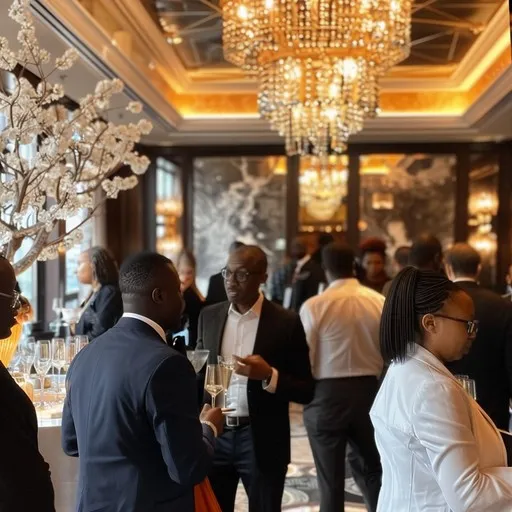
Photo: sophisticated upscale networking event with diverse affluent professionals in modern venue, via images.stockcake.com
For most of the twentieth century, the grammar of elite status in America was legible to anyone who cared to read it. The right zip code. The right club. The right label visible at precisely the right angle. Prestige was largely a matter of acquisition — of demonstrating, through the accumulation of recognized markers, that one had arrived at a particular stratum of society.
That grammar is being rewritten. And the revision is being led, with considerable force, by the very demographic cohorts that once seemed most likely to perpetuate the old conventions.
A Generation Redefining the Rules
Affluent millennials — broadly defined as Americans now in their thirties and early forties with significant disposable income — and their Gen X predecessors have developed a notably different relationship with status than the generations that preceded them. Having come of age during a period of intense cultural transparency, in which the mechanics of luxury marketing became widely understood and somewhat demystified, these cohorts tend to respond with skepticism to status signals that feel manufactured or transactional.
What they respond to instead is harder to commodify and considerably more difficult to fake: genuine access, meaningful connection, and the sense that one's membership in a particular community reflects something true about who they are rather than simply what they can afford.
This shift has enormous implications for how premium social platforms and members-only communities must position themselves in 2024. The question is no longer simply "How exclusive is this?" The more pressing question has become: "Exclusive in service of what?"
The Limits of the Legacy Model
The traditional country club, as a social institution, offers a useful lens through which to examine this cultural evolution. For decades, these organizations served as the primary infrastructure of elite American social life — providing not only leisure facilities but a carefully maintained social ecosystem in which relationships of consequence could be cultivated.
Yet the country club model has struggled to adapt to a generation that prizes dynamism over tradition, global connectivity over regional insularity, and experiential richness over institutional affiliation. Waiting lists that once conferred prestige now read, to younger affluent Americans, as evidence of rigidity. Dress codes that once communicated shared values now feel like mechanisms of exclusion for its own sake.
The institutions that have navigated this transition most successfully are those that retained the essential promise of the legacy model — genuine selectivity, meaningful community, a shared elevation of standards — while radically reimagining the form through which those qualities are delivered.
Experience as the New Estate
If one were to identify a single organizing principle behind the evolution of elite social culture in America, it would be this: experience has replaced possession as the primary vehicle of prestige.
This is not merely a matter of preference. It reflects a sophisticated understanding of where genuine value resides. A luxury automobile depreciates. A designer garment goes out of fashion. But the memory of a perfectly curated evening — an intimate gathering at which you were introduced to a person who changed the trajectory of your professional life, or at which you witnessed a performance that altered your understanding of what art could be — appreciates over time, growing richer and more meaningful with each retelling.
Platforms and communities that understand this dynamic are building their value propositions accordingly. The most compelling members-only offerings in 2024 are not selling access to a room. They are selling access to a category of experience — and, crucially, to the caliber of individual who inhabits that category alongside you.
This is the animating philosophy of Amar Club: that the most valuable thing a premium community can offer its members is not a service or a venue, but a consistently elevated context in which their most important relationships can develop.
Belonging Without Homogeneity
One of the more nuanced developments in elite social culture is the growing appetite for communities that offer genuine belonging without demanding conformity. The old model of exclusivity was often, at its core, a model of homogeneity — selecting members who shared not only economic standing but background, aesthetic, and worldview.
The communities that are generating the most meaningful engagement among affluent Americans today tend to operate on a different principle. They select for values and appetite rather than background and biography. The common thread among their members is not where they came from but what they are reaching toward: a commitment to excellence, a genuine curiosity about ideas and people, and a willingness to invest in experiences that challenge as well as comfort.
This approach produces something that the homogeneous model rarely achieved: genuine surprise. When a community is composed of individuals who share essential values but bring radically different perspectives, the interactions that result have a quality of discovery that cannot be manufactured by any other means.
The Strategic Dimension of Social Investment
It would be incomplete to discuss the evolution of elite social culture without acknowledging its strategic dimension. Affluent Americans — particularly those who have built or are actively building significant professional influence — increasingly view their social investments through a lens of intentionality.
This does not mean that their participation in premium communities is cynical or transactional. It means that they are sophisticated enough to recognize that the relationships formed within a thoughtfully curated environment have the potential to shape their professional and creative trajectories in ways that no conventional networking event could replicate.
The members-only community, at its best, functions as a kind of sustained, elevated context — a space in which trust can develop organically over time, in which the quality of conversation is consistently high, and in which the people you encounter are selected with sufficient care that serendipitous, consequential connections become not exceptional but routine.
What Prestige Looks Like From Here
The future of elite social culture in America, if the current trajectory holds, will be defined less by what members possess and more by what they have experienced and whom they have known. The most coveted invitation will not be to the largest event but to the most considered one — the gathering at which the guest list was assembled with genuine intention and the evening was designed to produce something that could not have happened anywhere else.
That is a future that Amar Club is not merely anticipating but actively constructing — one curated experience, one meaningful introduction, one unforgettable evening at a time. In a culture increasingly saturated with the superficial, genuine belonging has become the rarest luxury of all.