Curated, Not Crowded: How Membership-Driven Clubs Are Reshaping Premium Live Entertainment
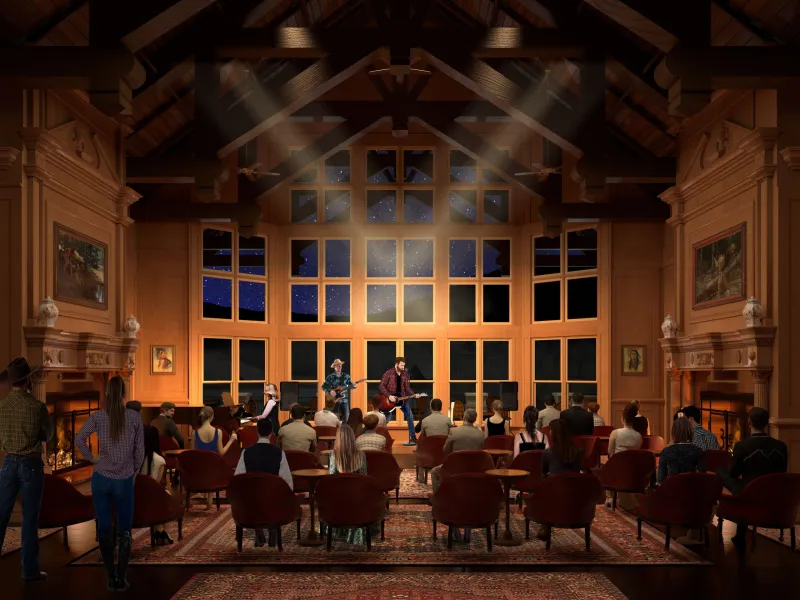
Photo: exclusive private concert intimate venue elegant audience formal evening, via threeforksranch.com
There was a time when a front-row seat at a marquee concert or a reserved table at a celebrated performance was considered the pinnacle of live entertainment. Today, that benchmark has moved considerably. For a particular tier of American audience — one accustomed to precision, privacy, and personalization — the ticket itself is almost beside the point. What matters now is the entire architecture of the experience surrounding it.
This is the world that exclusive membership communities have built, and in 2024, it is flourishing.
The Shift From Transaction to Transformation
Traditional live entertainment has long operated on a transactional model: a consumer purchases access to a finite event, attends, and departs. The relationship between venue, performer, and audience begins and ends at the box office. For many, this remains entirely satisfactory. But for a growing segment of culturally engaged Americans, something has changed.
What high-net-worth individuals increasingly seek is not merely an event but an experience ecosystem — a continuum of engagement that begins well before the curtain rises and extends long after the final note fades. Membership-based platforms have recognized this appetite and responded with extraordinary sophistication.
At Amar Club, this philosophy is foundational. The platform was designed with the understanding that elite audiences are not simply purchasing entertainment; they are investing in a community that reflects their values, their standards, and their desire for genuine human connection within curated environments.
What Separates a Premium Experience From a Mainstream Event
The distinction between a premium membership event and a conventional public concert or theatrical production is not merely cosmetic. It is structural.
Consider the matter of scale. Mainstream venues are engineered for maximum capacity — the economics demand it. A membership-exclusive performance, by contrast, is deliberately constrained. Intimacy is not incidental; it is the product. When a celebrated jazz ensemble performs for an audience of eighty rather than eight thousand, the acoustic quality, the sightlines, and the performer-audience dynamic are categorically different. Members are not spectators. They are participants in something rare.
Beyond scale, curation plays a decisive role. Premium entertainment communities employ dedicated programming teams whose sole mandate is to identify experiences that cannot be replicated through conventional channels. This means securing residencies with artists who rarely perform publicly, commissioning original works for member audiences, and partnering with venues — private estates, historic landmarks, architectural landmarks not typically open to the public — that carry their own weight of significance.
The psychological dimension here is not trivial. Research in consumer behavior consistently demonstrates that scarcity and exclusivity amplify perceived value. When an individual knows that fewer than one hundred people in the country witnessed a particular performance, the memory of that evening carries a permanence that no stadium concert can match.
Invitation-Only Venues and the New Geography of Culture
One of the more compelling developments within elite entertainment circles is the emergence of what might be called hidden venue culture. Across cities such as New York, Los Angeles, Chicago, and Miami, a constellation of spaces exists almost entirely outside public awareness — converted warehouses in Brooklyn, restored Gilded Age townhouses in Manhattan's Upper East Side, private garden pavilions in Malibu — each serving as the backdrop for experiences available only to those holding the right membership credentials.
These spaces are not merely beautiful. They are strategically chosen to reinforce the sense of discovery and privilege that premium audiences prize. Arriving at an unmarked door in a nondescript building, only to find oneself inside an exquisitely designed performance space, generates a particular kind of delight that no conventional venue can manufacture.
Amar Club has embraced this geography of surprise, curating events in locations that carry genuine narrative weight. The setting is never incidental — it is co-author of the experience.
The Psychology of Membership Investment
Why are affluent Americans increasingly redirecting entertainment spending from individual ticket purchases toward annual membership commitments? The answer lies in a convergence of psychological and social factors that deserve careful examination.
First, there is the matter of identity. Membership in an elite community functions as a form of self-expression. The clubs and platforms one belongs to communicate something about one's aesthetic sensibilities, professional standing, and social priorities. In an era when traditional status symbols have grown somewhat predictable, cultural membership offers a more nuanced and intellectually credible marker of distinction.
Second, there is the concept of anticipated pleasure — the psychological benefit derived not from an experience itself but from the knowledge that exceptional experiences are forthcoming. A robust membership calendar, populated with events spanning intimate performances, exclusive film screenings, private gallery openings, and curated culinary experiences, generates a sustained sense of anticipation that individual ticket purchases simply cannot replicate.
Finally, and perhaps most importantly, there is community. The most sophisticated membership platforms understand that their most valuable offering is not any single event but the network of like-minded individuals that forms around those events. When a member attends a private chamber music evening and finds themselves in conversation with a prominent architect, a celebrated novelist, and a pioneering technologist — all of whom share a commitment to cultural excellence — the value generated extends far beyond the music itself.
Emerging Trends Defining the 2024 Landscape
Several distinct trends are currently shaping the premium membership entertainment space in the United States.
Hyper-personalization has moved from aspiration to expectation. Members increasingly anticipate that platforms will learn their preferences — preferred genres, favored formats, dietary considerations, even scheduling patterns — and tailor invitations accordingly. The era of one-size-fits-all programming, even within exclusive settings, is drawing to a close.
Cross-disciplinary programming is gaining considerable momentum. The most innovative membership communities are dissolving the boundaries between art forms, presenting evenings that weave together live music, culinary artistry, visual art installations, and intellectual discourse into unified experiential narratives. These multi-sensory events resist easy categorization, which is precisely their appeal.
Sustainability and intentionality have emerged as genuine considerations for premium audiences. High-net-worth members are increasingly attentive to the values embedded in the experiences they support. Platforms that demonstrate a commitment to artist welfare, environmental responsibility, and authentic community investment are earning loyalty that transactional competitors cannot match.
The Amar Club Standard
At Amar Club, every element of the member experience is evaluated against a single question: does this reflect the standard of excellence our community deserves? It is a deceptively simple criterion that demands constant vigilance.
The live entertainment landscape of 2024 is more fragmented, more competitive, and more creatively rich than at any previous moment. Within that landscape, membership-driven communities occupy a singular position — not merely as providers of access, but as architects of meaning. For those who have experienced the difference, there is simply no returning to the ordinary.
The elite experience is not a luxury. For those who understand its dimensions, it is a necessity.