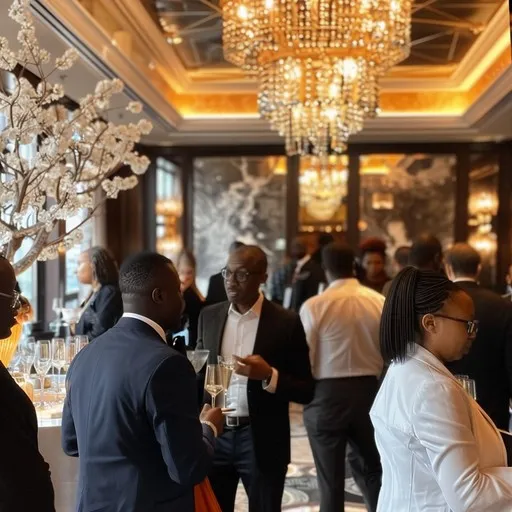
The Guest List as Masterpiece: How America's Most Discerning Hosts Curate Their Inner Circles
Photo: Prime Minister's Office, GODL-India, via Wikimedia Commons
There is an art form that receives almost no public attention, yet shapes some of the most consequential relationships in American cultural and professional life. It is the art of the guest list — specifically, the deliberate, psychologically sophisticated process by which elite hosts decide who receives an invitation to their most selective gatherings.
For those who have spent years inside premium membership communities, the mechanics of this process are both fascinating and instructive. At Amar Club, where the curation of experience is foundational to everything we do, understanding how the finest social architects approach guest selection offers genuine insight into what separates a remarkable gathering from a merely expensive one.
Beyond the Balance Sheet
The first and perhaps most important truth about elite guest curation is that financial standing, while relevant, is rarely the primary criterion. Hosts who operate at the highest levels of social orchestration are remarkably consistent on this point.
"Wealth is a baseline, not a differentiator," explains one New York-based event curator who has assembled gatherings for Fortune 100 executives, prominent artists, and policy influencers for over a decade. "Everyone in the room has resources. What I'm actually asking is: does this person generate energy or extract it?"
That distinction — between those who elevate a room and those who diminish it — sits at the heart of sophisticated guest selection. The hosts who produce the most memorable, most talked-about gatherings (privately, of course) are those who think of their guest list the way a composer thinks of an ensemble. Every voice must serve the whole.
The Chemistry Audit
Practical guest curation begins long before invitations are extended. The most methodical hosts conduct what might be called an informal chemistry audit — a mental mapping of how prospective guests will interact not just with the host, but with one another.
This process involves several distinct considerations. First, there is conversational range: does the individual bring perspectives that will create productive friction or unexpected insight? A room full of people who agree on everything, regardless of how accomplished they are, produces a flat experience. Diversity of thought — genuine, substantive diversity — is a prized ingredient.
Second, there is what social strategists sometimes call "reciprocal generosity." The guests most consistently re-invited to exclusive circles are those who give as actively as they receive. They make introductions. They share knowledge without being asked. They remember details about others and follow through on commitments made in passing conversation.
"I watch how someone behaves in the first twenty minutes," notes a Los Angeles-based cultural entrepreneur who hosts quarterly salons attended by figures from the entertainment, technology, and philanthropic sectors. "Are they scanning the room for someone more important to talk to, or are they fully present with whoever is in front of them? That tells me everything about whether they belong here."
The Unspoken Criteria
Beyond chemistry and generosity, several less obvious criteria consistently appear in conversations with experienced hosts and social architects.
Discretion ranks exceptionally high. The willingness — and proven ability — to keep the contents of a private gathering genuinely private is, in many circles, the single most valuable credential a guest can carry. In an era when everything seems destined for documentation, individuals who understand the value of an off-the-record experience are increasingly rare and correspondingly prized.
Earned credibility over projected status is another distinguishing factor. Hosts with refined social instincts are skilled at distinguishing between individuals who have genuinely built something — a body of work, a community, a reputation grounded in substance — and those who have simply positioned themselves effectively. The former tend to make for far richer conversation.
Timing awareness — the social intelligence to know when to speak, when to listen, when to exit a conversation gracefully — is a subtler but equally significant quality. Elite gatherings have a rhythm, and guests who disrupt that rhythm, however unintentionally, tend not to receive repeat invitations.
The Role of Sponsorship
In many of the most exclusive communities, direct applications for membership or attendance are less common than the sponsorship model — wherein existing members vouch for prospective guests. This system places the responsibility for curation partly on the community itself, creating a distributed accountability that tends to maintain standards more effectively than any formal vetting process.
At its best, the sponsorship model means that every guest in the room has been personally endorsed by someone with a stake in the community's quality. The implicit social contract is clear: the sponsor's judgment and reputation are on the line alongside the guest's behavior.
"When you know that your invitation came through someone who trusts you, and that their standing is connected to how you show up, it changes how you engage," observes one long-standing member of a private dining society based in Chicago. "You're not just representing yourself. You're honoring a relationship."
What This Means for Aspiring Members
For those seeking access to more selective circles, the implications of this framework are both clarifying and actionable. The path to coveted invitations is rarely paved with aggressive self-promotion or credential-signaling. It is built, instead, through consistent demonstration of the qualities that discerning hosts actually value.
Showing up fully present. Contributing without expectation of immediate return. Protecting the confidentiality of private experiences. Building genuine relationships rather than transactional ones. These behaviors, sustained over time, create the kind of reputation that travels ahead of you into rooms you have not yet entered.
The guest list, at its finest, is not a roster of the most powerful people available. It is a carefully composed gathering of individuals whose presence, collectively, creates something none of them could produce alone. That is the standard to which the most accomplished hosts hold themselves — and the standard against which, whether they know it or not, every prospective guest is measured.
At Amar Club, this philosophy of intentional curation is not incidental to the experience we offer. It is the experience.