The Quiet Prestige: Why the Most Enviable Experiences Never Appear on Your Feed
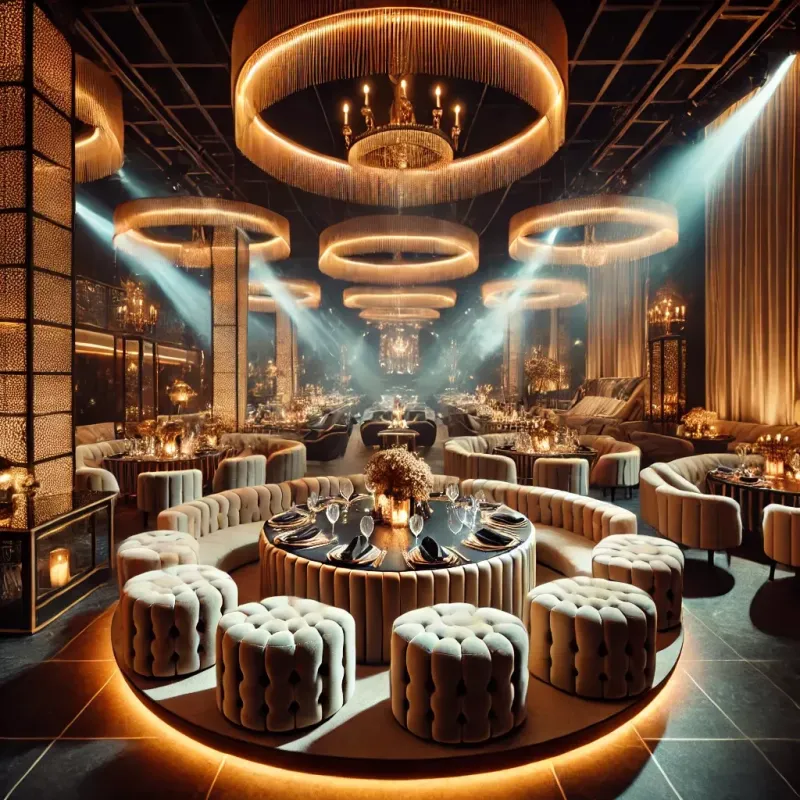
Photo: sophisticated private members lounge evening cocktails intimate gathering luxury, via i.pinimg.com
For roughly a decade, the architecture of social aspiration in America was built on visibility. The aspirational life was, by definition, a documented one — curated, filtered, captioned, and published for an audience whose approval served as both validation and currency. To be seen enjoying something exclusive was, in many circles, the entire point of enjoying it.
That architecture is quietly crumbling.
Among a specific and growing segment of affluent Americans — professionals in their thirties and forties, accomplished creatives, executives who have reached the upper registers of their industries — a meaningful cultural shift is underway. These individuals are not simply reducing their social media usage. They are actively migrating their social and entertainment lives into private membership communities where the defining feature is not visibility, but depth. Where the experience is the reward, full stop.
This is not a fringe phenomenon. It is a signal worth paying serious attention to.
The Exhaustion Beneath the Performance
To understand why this shift is happening, it helps to understand what it is a response to. The social media model of status-signaling is, at its core, an exhausting one. It demands constant content generation, continuous audience management, and an ongoing performance of a life that must be legible — and enviable — to strangers.
For individuals who have achieved genuine success, this performance increasingly feels not just hollow but counterproductive. The most interesting conversations cannot be captured in a thirty-second video. The most meaningful connections do not benefit from public documentation. And the most valuable experiences — the ones that actually change how you think or who you know — tend to occur in precisely the settings where phones are discretely absent.
"I spent years documenting experiences instead of having them," reflects one member of a private entertainment community based in the Northeast. "At some point I realized I couldn't remember the last time I was fully present somewhere. I was always half-composing the caption."
This sentiment, expressed in various forms, recurs with striking consistency among individuals who have made the transition from public social performance to private community membership. The word that appears most often is not "exclusive" or "prestigious." It is "present."
The Paradox of Invisible Exclusivity
Here is where the cultural analysis becomes genuinely interesting: the retreat from public visibility has not diminished the prestige of these private experiences. In many ways, it has amplified it.
There is a well-documented psychological principle at work here. Scarcity increases perceived value. But in the contemporary social landscape, a new and more nuanced form of scarcity has emerged — not just scarcity of access, but scarcity of documentation. When an experience leaves no public trace, it becomes, paradoxically, more coveted.
Consider the logic: if every notable gathering, every remarkable performance, every significant introduction were immediately broadcast across social platforms, the experience would be flattened into content. It would become equivalent to the thousands of other pieces of content competing for attention on the same feed. The act of publicizing the experience destroys a portion of what made it special.
Conversely, when an experience remains genuinely private — when the only people who know it happened are the people who were there — it retains a texture and weight that public documentation erodes. Word travels, but selectively. Reputation builds, but organically. The gathering becomes something people speak about in private, which is precisely the register in which social capital operates most powerfully.
"The most prestigious events I've attended in the last three years," observes a cultural strategist based in San Francisco, "are the ones I've never seen mentioned anywhere online. Not because they were secret, but because the people there understood that the experience was more valuable than the post."
From FOMO to Something Richer
The shift away from fear-of-missing-out as a primary social motivator toward what some have begun calling the joy of missing out — a deliberate, selective disengagement from the noise of mass social media — represents more than a lifestyle preference. It reflects a maturing relationship with status itself.
Younger iterations of prestige culture were largely performative: the right address, the right vehicle, the right table at the right restaurant, all documented and distributed. The prestige was, in a meaningful sense, located in the audience's recognition of it.
The emerging model locates prestige differently — in the quality of the experience itself, in the caliber of the people present, and in the depth of the relationships formed. The audience, in this framework, is not a social media following. It is the room.
This distinction carries real implications for how premium entertainment and membership communities must think about what they offer. The members migrating toward private platforms are not seeking experiences they can show off. They are seeking experiences they can actually inhabit — evenings that demand their full attention, conversations that require genuine engagement, connections that develop into something durable.
What Private Communities Offer That Platforms Cannot
The appeal of membership-based entertainment communities, at their finest, lies in precisely this capacity for genuine inhabitation. When a gathering is designed with the understanding that no one present will be performing for an external audience, the entire social dynamic shifts.
Guests arrive as participants rather than broadcasters. Conversations develop lateral complexity rather than being abbreviated for digestibility. Relationships form on the basis of actual interaction rather than profile curation. And the cumulative effect — over multiple gatherings, across a sustained membership — is the construction of a social world that has real texture and continuity.
This is what Amar Club is built around: the conviction that the most valuable experiences are the ones that unfold without documentation, that the most meaningful connections form away from the performance pressure of public platforms, and that true prestige — the kind that actually enriches life — is quiet by nature.
The members who understand this are not opting out of social life. They are opting into a richer, more deliberate version of it. They have recognized that the feed was never the destination. It was always, at best, a distraction from one.