Address Unknown: Inside the Underground Dining Movement Where the Location Is the Last Course
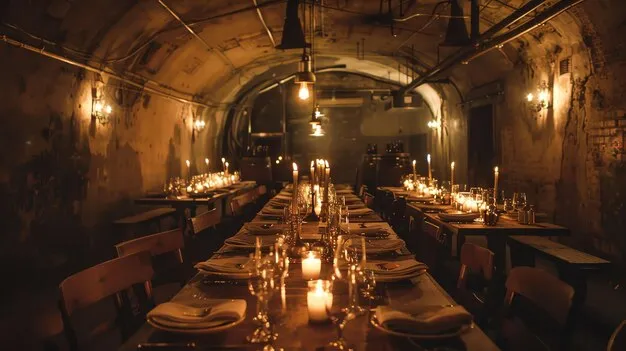
Photo: candlelit long dinner table underground supper club moody warehouse, via img.freepik.com
The text message arrives at 3:40 p.m. on a Thursday. It contains a cross street in Brooklyn, a parking instruction, and a single word of encouragement: dress warmly. By 7:30 that evening, forty strangers will be seated along a communal table in a converted printing warehouse, being served a nine-course meal by a chef whose name most of them will never learn.
This is the new anatomy of the American special-occasion dinner. No host stand, no OpenTable confirmation, no printed menu to slip into a drawer as a souvenir. In the underground supper club economy, the reveal is the product — and scarcity is the seasoning.
The Geography of Secrecy
The mechanics are deceptively simple. Operators build a list — sometimes a few hundred names, sometimes a few thousand — and communicate through encrypted group chats, rotating email aliases, or, in one Manhattan-based club's case, a phone number that changes quarterly. The venue is disclosed only hours before service, often via a pin dropped on a map that expires before dessert.
The practice has roots in the speakeasy revival of the 2010s, but today's iteration is more disciplined. These are not pop-ups in the loose, chaotic sense. They are tightly produced events with insurance, licensing workarounds, and waitlists that rival Michelin-starred rooms. A seat at certain Los Angeles gatherings reportedly changes hands on the secondary market for more than a first-class transcontinental ticket.
What distinguishes the movement is its insistence on incompleteness. The chef's identity is half-veiled — a first name, a résumé hinted at rather than stated. Menus are described in impressionistic fragments: smoke, citrus, a memory of the coast. Diners are asked, sometimes contractually, to leave their phones in pouches at the door.
Why Affluent Diners Are Buying Silence
The economics are counterintuitive. A tasting menu at an acclaimed restaurant might run $225. Its underground equivalent — no liquor license, mismatched chairs, a restroom behind a curtain — routinely commands triple, and sells out in minutes. The premium is not purchasing food quality, which is often excellent but not categorically superior. It is purchasing the narrative.
Consider what the traditional fine-dining experience has become for a certain class of American consumer: thoroughly documented, thoroughly reviewed, and therefore thoroughly predictable. Every dish has been photographed by thousands of predecessors. Every server's choreography has been rated on a five-point scale. The surprise has been pre-consumed by the crowd.
The secret supper club inverts this. There are no reviews to consult because there is nothing to review. The experience cannot be pre-validated, which means it cannot be pre-disappointed. For diners whose calendars are filled with optimized, algorithmically recommended everything, the un-googleable evening has become the rarest luxury of all.
There is also a quieter social calculus. To attend is to belong to a small, self-selecting cohort. To be invited to the next one is proof of standing. The dinner ends; the membership persists.
The Operator's Dilemma: Grow or Stay Golden
For the people running these clubs, the central tension is arithmetic. Word of mouth is the only marketing engine worth having, and every satisfied guest recruits three more applicants. But each new name on the list dilutes the very scarcity that made the club worth joining.
Some operators have adopted formal capping strategies — a fixed membership roster with a one-out, one-in policy modeled on legacy social clubs. Others have split the difference, creating a public-facing tier of larger, ticketed dinners that funds and feeds a private tier of invitation-only tables. The public tier generates revenue and rumor; the private tier preserves prestige.
The most successful operators treat their guest list the way a sommelier treats a cellar: curated, rotated, and never fully displayed. One West Coast organizer described the practice bluntly — the goal is not the largest audience but the right forty people in the right forty chairs.
The Photograph Ban and the Ethics of the Unshareable
The no-phone policy deserves its own scrutiny. Framed as a courtesy to fellow diners, it also functions as intellectual property protection. An experience that cannot be photographed cannot be copied, and cannot be reviewed, which means the operator controls the story indefinitely.
Diners, notably, do not seem to mind. If anything, the prohibition has become a selling point — a night off from the performance of documentation. Several attendees describe the sensation in almost therapeutic terms: eating without narrating, savoring without scoring.
Skeptics counter that secrecy is itself a marketing pose, a scarcity theater performed by operators who benefit enormously from the whisper. There is truth in the critique. But it misses why the format endures. The secrecy is not hiding a deficiency; it is manufacturing a condition — genuine uncertainty — that the modern leisure economy has nearly eliminated.
Where the Movement Goes Next
Expect the model to migrate. Early experiments are already appearing in the wellness retreat space, the live music world, and the travel sector, all borrowing the same grammar: withheld information, capped attendance, earned access. The supper club simply got there first because dinner is the most universal social currency America has.
For now, the rules remain unchanged. The message comes late. The pin drops at dusk. And somewhere in a warehouse, a garden, or a rooftop no listing will ever name, a chef nobody can Google plates the most talked-about meal in the city — for people who have agreed, in writing, not to talk about it in the only places where talking counts.
That, increasingly, is the reservation worth keeping.